



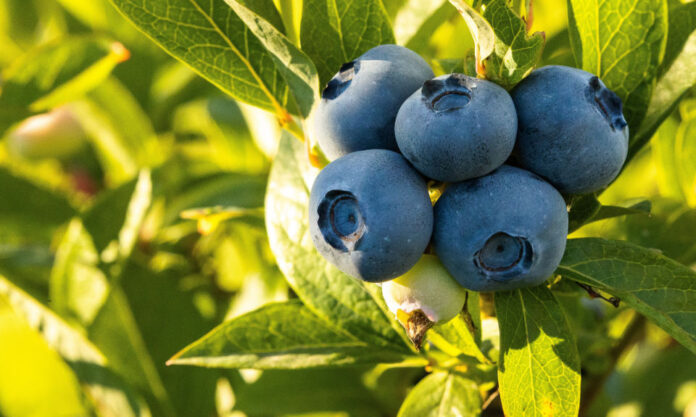



New agriculture has in recent years been a significant focus for Nanjing, given the considerable rural resources at the City’s disposal. One crop in particular has proved a winner; blueberries now being exported far and wide have become a key economic driver.
鉴于南京拥有大量农村资源,新农业近年来一直是南京的重点关注领域。尤其是有一种作物被证明是赢家;蓝莓现已广泛出口,已成为重要的经济驱动力。
Last year, sales from Nanjing-produced blueberries exceeded ¥100 million. Several batches of high-quality blueberries were even exported to the USA, Europe, Japan and other countries.
去年,南京产蓝莓销售额突破1亿元。多批优质蓝莓还出口到美国、欧洲、日本等国家。
On 6 June, a reporter for Nanjing Daily visited the Lishui Liang Organic Blueberry Planting Base. Jiang Zhangcai, who overseas planting management, revealed that each tree shall consumes approximately 20-25 kilograms of organic fertiliser.
6月6日,南京日报记者探访溧水亮有机蓝莓种植基地。海外种植管理人员江章才透露,每棵树大约消耗有机肥20-25公斤。
“A sapling pit is about 50 centimetres deep and 50 centimetres wide. Organic fertiliser helps us to ensure the organic-matter content of the soil”, said Jiang. “Compared with blueberries grown using chemical fertilisers, with organic blueberries, not only is the fruit bigger, but its nutritional value and taste are much better.”
“一个树苗坑深约50厘米,宽约50厘米,施用有机肥可以保证土壤的有机质含量。”蒋说。 “与使用化肥种植的蓝莓相比,有机蓝莓不仅果实更大,而且营养价值和口感也好得多。”
Liang Organic Blueberry is the first enterprise to grow organic blueberries in Lishui District of Nanjing. It is also one of the few such local producers to have passed certification for the EU, USA and Japan.
亮有机蓝莓是南京市溧水区第一家种植有机蓝莓的企业。它也是少数通过欧盟、美国和日本认证的本地生产商之一。
The blossoming of blueberry farming is not just an ecological equation, it’s also a purely economic matter. The cost of organic planting is twice that of traditional planting methods, but the income derived therefrom is more than double.
蓝莓种植业的蓬勃发展不仅仅是一个生态问题,也是一个纯粹的经济问题。有机种植的成本是传统种植方式的两倍,但由此获得的收入却是传统种植方式的两倍以上。
In the long run, planting costs shall continue to some down; hence retail investors and enterprises are now willing to switch to organic planting. Fresh, organic blueberries grown by Liang Organic Blueberry and other Nanjing-based producers can now be found on the shelves of supermarkets such as Hema, Costco and Sam’s Club.
从长远来看,种植成本将会继续有所下降;因此散户和企业现在愿意转向有机种植。梁有机蓝莓和其他南京生产商种植的新鲜有机蓝莓现在可以在盒马鲜生、好市多和山姆会员店等超市的货架上找到。
But growing blueberries in Nanjing is hardly a new idea. Our City was in fact one of the earliest areas in China to develop blueberry cultivation.
但在南京种植蓝莓并不是什么新鲜事。我市是我国最早发展蓝莓种植的地区之一。
Since the mid-1980s, blueberries have been cultivated in Baima Town of Nanjing’s Lishui District. At present, apart from Jiangbei New District and Qixia District, all districts in Nanjing have blueberry planting business. The total planting area is has attained a scale of over 1,000 hectares, of which more than 900 hectares are to be found in Baima Town. Now it’s in overdrive, as the numbers show.
20世纪80年代中期以来,南京市溧水区白马镇开始种植蓝莓。目前,除江北新区、栖霞区外,南京各区均有蓝莓种植业务。种植总面积已达1000多公顷规模,其中白马镇种植面积900多公顷。正如数字所示,现在它正处于超速状态。
Looking to Shitouzhai Village in Baima, its income of ¥370,000 in 2015 has seen a six-fold increase in 7 years, reaching ¥2,113,400 in 2022.
再看白马石头寨村,2015年收入37万元,7年间增长了6倍,2022年达到211.34万元。
That’s made an enormous difference in the standard of living for villagers; their 2015 per-capita income of ¥18,750 became ¥34,698 in 2022.
这对村民的生活水平产生了巨大的影响。 2015年的人均收入为18,750日元,2022年则为34,698日元。
Realising this, to a large degree, is technology. While Nanjing has an advantage for growing blueberries due to its latitude being similar to that of California and Texas, the quality of soil has always been a hurdle.
在很大程度上,实现这一点就是技术。虽然南京与加利福尼亚州和德克萨斯州的纬度相近,具有种植蓝莓的优势,但土壤质量一直是一个障碍。
Lu Lianfei, with the Institute of Botany at the Chinese Academy of Sciences in Jiangsu Province, said, “Nanjing’s soil is sticky and alkaline, with insufficient organic matter, less than 5 percent, to grow blueberries”.
江苏省中科院植物研究所陆连飞表示,“南京的土壤粘性偏碱性,有机质不足,不到5%,不适合种植蓝莓”。
Lu emphasised the need to rely on technology, improve the soil and introduce suitable equipment in order to create an environment suitable for blueberry growth.
卢强调,要依靠技术、改良土壤、引进合适的设备,创造适合蓝莓生长的环境。
Such bio-agriculture efforts have paid off, tougher with our City’s 40 year history in the blueberry business; Nanjing Baima National Agricultural Science & Technology Innovation Park was placed fourth in 2015 in the country’s national rankings.
这种生物农业的努力已经取得了回报,而且我们市在蓝莓产业方面已有 40 年的历史。南京白马国家农业科技创新园2015年全国排名第四。