


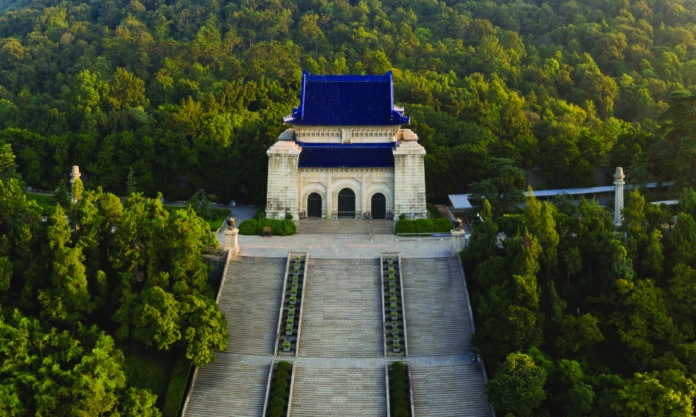
He dreamed of a strong, unified and democratic China, in death creating an everlasting symbol of China’s transition from empire to republic. Today, the Sun Yat-sen mausoleum remains a must see for both Chinese and international visitors to Nanjing.
他梦想着一个强大、统一和民主的中国,在死亡中创造了中国从帝国向共和国过渡的永恒象征。 今天,中山陵仍然是南京的中国和国际游客的必看之地。
The man himself, Sun (1866–1925) is also still revered as the revolutionary leader who played a pivotal role in overthrowing the Qing Dynasty and founding the Republic of China, here in Nanjing in 1912.
孙本人(1866-1925)仍然被推崇为革命领袖,他在1912年在南京推翻清朝和建立中华民国方面发挥了关键作用。
But his passing left a gaping hole of grief among the populace, to which the nationalist government was keen to pay due respect. Hence was launched a global design competition for his mausoleum. Winner was a young US-educated architect named Lü Yanzhi, for his modern reinterpretation of a classical Chinese tomb.
但他的去世在民众中留下了一个悲伤的空白,民族主义政府渴望对此表示应有的尊重。 因此,他的陵墓发起了一场全球设计竞赛。 获胜者是一位受过美国教育的年轻建筑师,名叫吕延志,因为他对中国古典墓的现代重新诠释。
Construction began in January 1926 and was completed in 1929. With thousands of labourers on the construction site, traditional materials were brought together with reinforced concrete to ensure durability.
施工于1926年1月开始,并于1929年完工。 建筑工地上有数千名工人,传统材料与钢筋混凝土结合在一起,以确保耐用性。
Pinnacle to the project is of course the Sacrificial Hall (祭堂) and Tomb Chamber (墓室), constructed from white marble and blue-glazed tiles, with a triple-eaved roof resembling traditional Chinese palatial architecture. Inside, a statue of Sun sits majestically, while the walls are inscribed with his “Three Principles of the People” (三民主义). Behind the hall lies the circular tomb chamber, where Sun’s sarcophagus is placed beneath a reclining statue.
该项目的巅峰之作当然是祭堂(祭堂)和墓室(墓室),由白色大理石和蓝色釉面瓦片建造,三重屋檐屋顶类似于中国传统的宫殿建筑。 里面,一座雄伟的太阳雕像,墙上刻着他的“三民主义”。 大厅后面是圆形墓室,太阳的石棺被放在一个倾斜的雕像下面。


It’s a well-known narrative. Less so, perhaps, is the story of the steps that every visitor must climb to visit the great revolutionary leader. For it is here that symbolism abounds.
这是一个众所周知的叙述。 也许,每个游客为了拜访伟大的革命领袖而必须攀登的台阶的故事就不那么如此了。 因为正是在这里,象征主义比比皆是。
As many a tired pair of legs will attest, 392 steps are to be ascended from the white marble archway at the Mausoleum’s base inscribed with another of Sun’s founding principals; “Universal Love” (博爱).
正如许多疲惫的双腿将证明的那样,392级台阶将从陵墓底部的白色大理石拱门上升,上面刻有太阳的另一个创始原则;“博爱”。
Those 392 steps are mainly significant for reflecting those Three Principles of the People, the nine provinces of China that Sun sought to unify, combined with the two characters of his name (中山).
这392个步骤主要用于反映“人民三原则”,即孙中山试图统一的中国九省,以及他名字中的两个字。
But the true kicker is the optical illusions experienced by visitors. On the way up, they see only steps, symbolising struggle; looking down from the top, only the platforms separating the sets of stepsare visible , as symbols of achievement and vision.
但真正的刺激是游客所经历的视觉错觉。 在上升的路上,他们只看到台阶,象征着奋斗;从顶部往下看,只有分隔台阶的平台可见,是成就和愿景的象征。
If ever there was an architectural “pièce de résistance” to top all others, it must surely be the case that Sun Yat-sen’s Mausoleum has few contenders.
如果曾经有一个建筑“抵抗力”来超越所有其他建筑,那肯定是孙中山的陵墓很少有竞争者。