



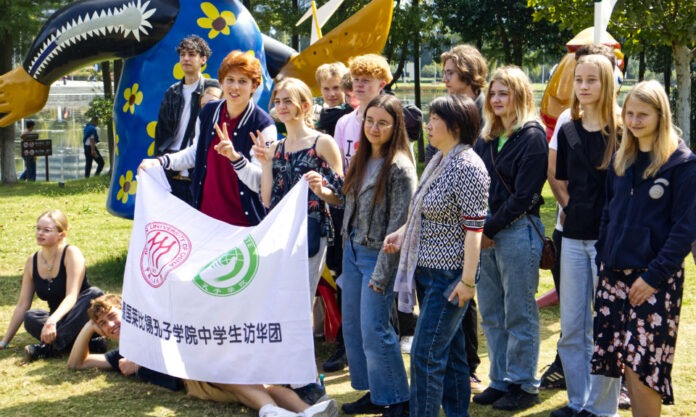



High schoolers studying Chinese in Leipzig realised a milestone the past week for their being the first trip here made by a particular learning institute in Germany in over 3 years. They made the most of it too, with a packed program full of culture and learning.
Yesterday, 11 October, marked 51 years since the People’s Republic of China and the Federal Republic of Germany established diplomatic relations. Hence, it was a fitting day for the German students to be visiting the Nanjing Sister Cities Exhibition Hall.
Hosted in China during their trip by Renmin University in Beijing, the 22 students are all enrolled at the Confucius Institute in Leipzig, that in 1988 was one of the first cities to become a sister to Nanjing.
At the Exhibition Hall, the student delegation were welcomed by the Foreign Affairs Office of Nanjing Municipal People’s Government and the Nanjing Peopleʼs Association for Friendship with Foreign Countries. The Nanjing Foreign Affairs Service Association was also on site to give a helping hand.
Touring the exhibition, The Nanjinger found the time to speak with two of the students; Maricel (16) and Daniel (17), both from Leipzig and who can both speak Russian, English, German, French and now Chinese, having studied part time with the Institute for 2 years.
“I think we have both studied Chinese not only for the language, but also because we are really interested in the cultural meaning and the history as well”, said Daniel.
On the difference between the Chinese they have learned in Germany and the real-world of everyday life in the Middle Kingdom, Daniel said, “The Chinese speak really fast and some sounds are not exactly on the point”.
Maricel added, “I’m actually surprised at myself; I can understand almost everything, but I don’t speak so much. But the Chinese I learned in my lessons is really practical here in China; for example, at the market we are often buying things and I always say, ‘That’s too expensive! Can you do it a little cheaper?’”.
In additional to her language skills, Maricel loves playing musical instruments. She said, “Chinese music fascinates me, so I have decided to buy an erhu while I’m here, and not only that, also a guzheng and a pipa, and take them all back to Germany”.
During their few days in Beijing, the students visited the famous sights, as well as the 798 Art Zone and some local hutongs, while in the Southern Capital they took in Nanjing University for a presentation about John Rabe and the history of Nanda, as well as finding time for our local scenic spots.
Also while in our fair City, the delegation was shown around a local school’s campus to then engage in various activities with the students; table tennis, volleyball, badminton, calligraphy, music and more.
As to the highlights of their trip, all were virtually united in their particular enjoyment of the Great Wall, Tianamen Square and the Forbidden City in Beijing; Confucius Temple and Sun Yat-sen’s Mausoleum in Nanjing; and of course, dumplings, everywhere.