





Urgently in need of a boost? We’ve all been there, which is why we often seek out those trusty providers of shared-power banks which have become ubiquitous across our urban-China landscape. Now though, there’s a difference; they are coming to us.
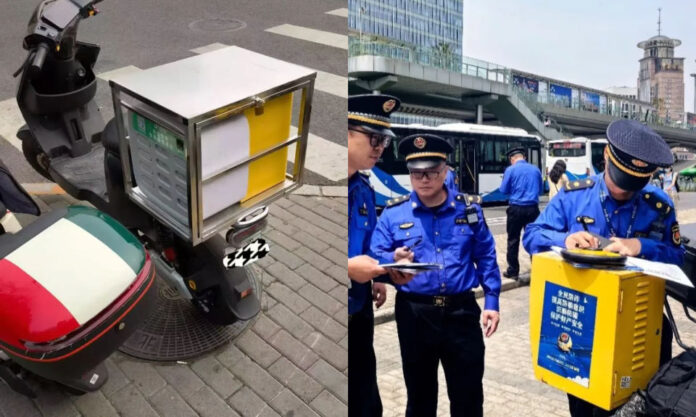
Operating without fixed locations, these are e-bikes upon the back of which is a shared-power bank podium. Such bikes have recently appeared on the streets of Shenzhen and Shantou in Guangdong Province, but have now even made it to the Lujiazui Ring Road in Shanghai, Daxinggong and Confucius Temple in Nanjing, and West Lake in Hangzhou.
On the face of it, there’s nothing not to love. The operators of such bikes come and go as pedestrian traffic fluctuates; outside a hospital for an hour, a tourist spot for the next and then a popular restaurant area, and so on.
Scanning the QR code on the power bank directly redirects to official mini programs such as “Meituan Power Bank” and “Energy Monster”, with the remaining steps identical to the renting procedure elsewhere.
Images shared by Chinese media show that some such shared power-bank units are independent-battery dependent, while others are connected to the e-bike batteries themselves.
Therein lies the problem. With exposed wires around the vehicles. Many citizens have expressed concern that such modifications are too dangerous, posing significant safety hazards and the potential for electrical leakage during rain.



Others though are more supportive of such enterprising operators, seeing it as a money-making machine.
So, just what is the cost of modifying these power bank-dedicated vehicles?
According to Litchi News, a reporter consulted an e-bike repair shop owner who stated that simply adding an “inverter” to convert the low voltage of the bike’s battery to 220V can power the power-bank podium.
But the owner also admitted that while modification is possible, it is not recommended. Furthermore, searching for keywords on e-commerce platforms and secondhand online trading platforms reveals numerous individuals and businesses selling “dedicated transformers for shared-power banks”, priced from ¥80-150.
Such transformers lack a brand name, manufacturer, address and contact information on their labeling.


From a legal standpoint, Article 12 of the “Jiangsu Province E-Bike Management Regulations” for example, stipulates that no unit or individual may modify the motor and battery of an e-bike, or replace them with motors and batteries that do not meet mandatory-national standards.
Those concerns aside, many of these operators are earning scores of renminbi every day from their mobile efforts.
That’s because of the business model for shared power-bank units. Meituan, Energy Monster and now even Douyin have arranged it so that 80 percent of the rental for power banks is typically given to the point of rental. This is the incentive that lies behind the emergence of shared power-bank podiums on the back of e-bikes.
Despite the rapid rise of the new enterprise, Meituan has not been slow to respond, already equipping its new e-bikes with two shared-power banks, directly utilising the bike’s own power supply.
With such use of shared-power banks as an entry point for high-frequency service, the move is expected to connect to more local-life services in the future.