






Many a parent of a teenager will be aware of their offspring’s enterprising endeavours. Initially, that may be making stuff to sell to their classmates. But teenagers grow up and times change. And many now realise the market is much bigger than they imagined.
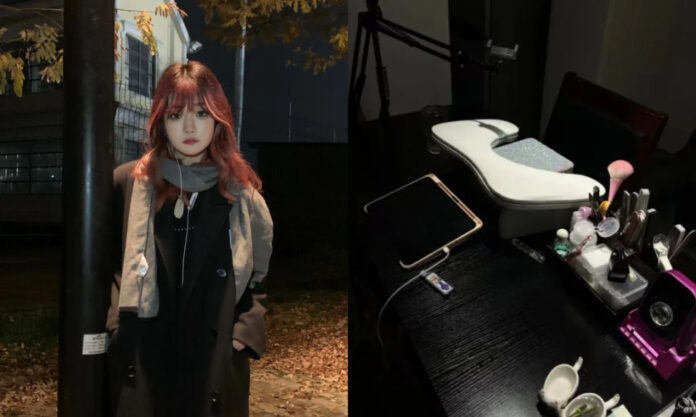
Little Deer is the online name by which one student at a 985 Project university in Xi’an goes who has opened a nail shop in the empty dormitory next door to hers. One night, some time after 21:00, she received a message from someone 20 kilometres away who intended to take a taxi to get her nails done right away. Little Deer reflected that being idle is idle anyway; better to earn some money. She immediately rolled out of bed.
Data released recently shows that more than 80 percent of college students in China have the experience of working part time to make money. The most common areas are teaching and training, writing and catering.
But in the past 2 years, a new trend has emerged for both college students and high school students alike; opening a shop in a dorm.
With so many colleges and universities across the country, a wide variety of dormitory shops have sprouted. With everything from nails, makeup and desserts, to coffee and printing, the phenomenon is comparable to a shopping district.
It’s little wonder too, since there are enormous advantages to having a shop in a dormitory compared to off-campus entrepreneurship, as the WeChat official account “Ribbon” (一条) reports.
After all, there is no need to pay rent, no need to choose a location and no need for renovations. Then there is the large and stable base of potential customers, plus the flexible-working hours which for many can be just 1 or 2 hours per day. It represents enough to live on.



In the case of Little Deer, she can make over ¥3,000 per month during the low season and even ¥8-9,000 in high season.
Meanwhile, the late night order referred to earlier is far from her first. Before the holidays, she will need work until midnight. As she says, “Nails are already a very common thing, and almost every female college student has one on her hand.” In the 3 years since her dormitory shop opened, Little Deer has received more than 600 guests.
Then there is the interesting case of Yiqi, a senior student at a dual-campus school in Nanjing who is about to graduate. Today, when physical-clothing stores are almost unheard of, she has opened such a shop in her dormitory. To many perhaps an usual route to take, but Yiqi sees its as a business opportunity.
“I love to buy clothes and make up, and for many girls like me, it seems as if there is always a shortage of a new item”, said Yiqi. “For example, after a day of class, you want to go out to dinner or for fun, but when you rummage through your boxes, you just don’t have a suitable item to wear.”
With a high proportion of girls in her school and its campus located in a relatively remote location, going to a mall is sure to involve a taxi or the metro. And many girls after all, like shopping very much!
“Buying clothes online, many of them are pre-sold and you have to wait 10 days or more, which is the shortcoming of e-commerce”, Yiqi added. “I thought how great it would be if there was a convenient, cost-effective place in the dorm, where you could also choose you own styles.”



Up north in Beijing, 16 year old Huang Huang studies at an international school, in which the canteen is crowded during peak hours with long queues. High-school students are growing physically, and they often feel hungry in the afternoons and evenings.
Swiping short videos of people opening stores and packaging online, it hit her that perhaps she could start a snack shop at school to provide more options for her classmates.
Partnering with several classmates, their operation began with just ¥100 as start-up capital. The format is simple; to ensure food safety, they buy from Sam’s Club, items such such as cakes, chocolate cookies, soufflés and meat pies, as well as healthier foods including milk and juice. Upon receipt, Huang Huang’s team divide them up at noon the same day, wrap them, add customised stickers and put such small packages on the shelves.
Initially, the school did not agree with Huang Huang to open a shop therein, but the team volunteered to communicate with the teaching director and the principal, explaining to them the benefits of opening a snack shop for their classmates.
Finally the school was convinced. On account of this experience, Huang Huang found that she was more daring to communicate with others, and that she was no longer afraid to face adults who are more powerful than herself.