




Nanjing’s attempts at getting its citizens to correctly classify their rubbish have been, well, a bit hit and miss. Many are just too lazy, or lack a degree of knowledge as to environmental protection. Perhaps a couple of the latest initiatives offer hope; pay people.
A few days ago, Pancheng Subdistrict in Jiangbei New Area of Nanjing’s Pukou District launched their all-new new approach to the sorting of household waste. And key to it was one of those relics from COVID that continue to dot our urban landscape; a much-hated former nucleic-acid testing (NAT) booth.
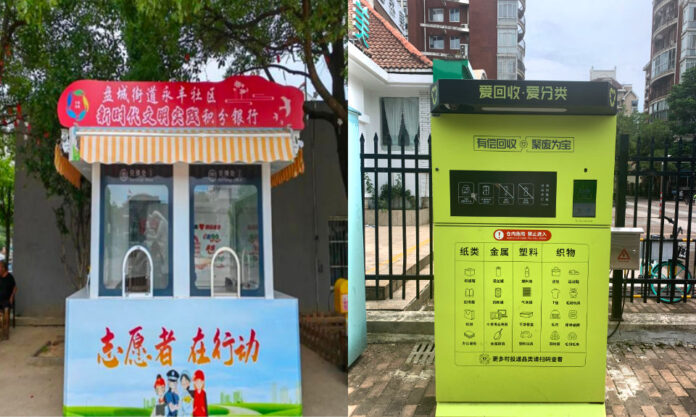
The booth in question is located in the Yumin Jiayuan Residential Community. Tarted up with colourful slogans in a somewhat childlike font, and even a cute orange awning, this is now a NAT booth testing community residents as to their rubbish-sorting skills.
And rewarding them, as the Yangtze Evening News reports. Qualifying residents who turn up with their rubbish correctly classified are entitled to points, which, after a certain period, may be exchanged for sundries such as eggs, at a dedicated spot not open to the general public and where prices are marked in points.
The booth remains something of a work in progress for the moment, being only open on Thursday afternoons from 13:30 to 16:30.
In other cities of our very own Jiangsu Province, NAT booths have also been repurposed, in Suzhou as stalls selling Chinese New Year foodstuffs and handicrafts, for example, as this publication reported. But this is the first time The Nanjinger has come across one being used for rubbish classification.
Elsewhere, some parts of Nanjing are seeing the rewards-for-rubbish concept being applied through automation.
Their initially menacing look dispelled by being a shade of green implicating some kind of eco credential, the boxes will deposit funds into a donor’s WeChat upon receipt of recyclables.
The Nanjinger spoke with one man who had managed to stuff the machine with a bunch of flattened cardboard boxes. ¥0.8 was the reward for his effort to his WeChat, being the amount paid out by the machine for each kilogram of recyclable rubbish.
The machines accept all the items that one would expect in the recycling department, plus a few surprises; small appliances, computers and down jackets for example.
Such recent developments show that Nanjing’s “Regulations on the Management of Domestic Waste in Nanjing”, enacted on 1 November, 2020, and making the separating of household refuse a mandatory requirement, now lie in tatters. Appealing to people’s pockets may be the only way to pick up the pieces.