



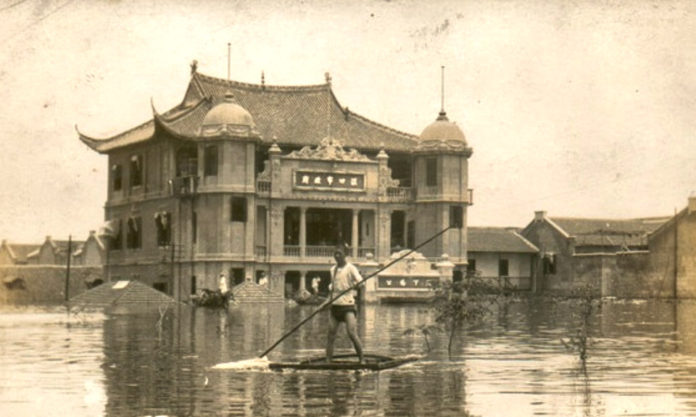



With few places in China to escape the heavy rainfall forecast for the coming days, it’s worth a sobering reminder of events this time 90 years ago, when millions perished in devastating floods in Nanjing and across east China.
由于未来几天中国几乎没有地方能逃脱预计的强降雨,因此值得人们清醒地回顾90年前的这个时候发生的事件,当时南京和中国东部地区数百万人在毁灭性洪水中丧生。
According to reports, meteorology is warning of concentrated precipitation in many regions of Anhui, Guizhou, Inner Mongolia, Hainan, Hebei, Henan, Hubei, Hunan, Jiangsu, Sichuan, Tibet and Yunnan. Also not spared will be Beijing, Chongqing and Tianjin. The rains are in addition to be accompanied by increasingly high temperatures and humidity.
据报道,气象预警安徽、贵州、内蒙古、海南、河北、河南、湖北、湖南、江苏、四川、西藏、云南等地多地出现集中降水。北京、重庆和天津也未能幸免。此外,降雨还伴随着越来越高的气温和湿度。
It’s a grim reminder of 1931 indeed. This was the year when, between June and August, high rainfall in the spring was compounded by no less than nine cyclones (the region’s July average is two). This produced the Yangtze River’s highest levels since records began and what is perhaps the worst flooding in history.
这确实令人回想起 1931 年。今年 6 月至 8 月期间,春季降雨量高,且伴有不少于 9 次气旋(该地区 7 月平均为 2 次)。这导致了长江有记录以来的最高水位,这可能是历史上最严重的洪水。
In the book. “The Nature of Disaster in China; The 1931 Yangzi River Flood” (Cambridge University Press; 2018), Chris Courtney notes estimates of 3.7 to 4 million deaths, writing that such theories enjoy “great currency online, helping the 1931 flood to secure its position on sensationalist lists of the world’s deadliest disasters”.
书中。克里斯·考特尼 (Chris Courtney) 在《中国灾难的本质;1931 年长江洪水》(剑桥大学出版社;2018 年)中指出,估计有 3.7 至 400 万人死亡,并写道,此类理论“在网上很受欢迎,帮助 1931 年洪水确保了其在世界上最致命灾难的耸人听闻的名单上的地位”。
But the numbers were an amalgamation. An official report put the number of drownings at 140,069. In the flood’s wake came diseases, including cholera, measles, malaria, dysentery and schistosomiasis. And then there was widespread famine caused by the destruction of farmland.
但这些数字是一个合并。官方报告称溺水人数为 140,069 人。洪水过后,疾病随之而来,包括霍乱、麻疹、疟疾、痢疾和血吸虫病。然后农田被毁,引发了大范围的饥荒。
No matter the final total, it is generally accepted that the floods of 1931 in Nanjing, Wuhan and the surrounding areas caused over 2 million fatalities.
无论最终的总数如何,普遍认为1931年南京、武汉及周边地区的洪水造成了超过200万人死亡。
Reaction to the flooding ranged from tragic to comical. A British Movietone News report from the time available on YouTube captures local people’s efforts at flood protection by building improvised dykes en masse and the citizens of Hankou (Wuhan) wading in the streets.
人们对洪水的反应从悲惨到滑稽不等。 YouTube 上当时发布的英国 Movietone News 报道记录了当地人通过集体搭建临时堤坝来防洪的努力,以及汉口(武汉)市民在街上涉水的情况。
Enterprising locals who normally pulled people around in rickshaws also suddenly had a new opportunity on their hands. According the website, China Dialogue, “Those who could not afford the grossly inflated fares took to the water in a bizarre flotilla of improvised vessels: rafts made from doors, inflated goatskins and wooden bathtubs. Some people even emptied out coffins and used them as canoes”.
平时开人力车拉人的有进取心的当地人也突然有了新的机会。据中外对话网站报道,“那些无力承担高昂票价的人乘坐由简易船组成的奇特船队出海:用门、充气山羊皮和木制浴缸制成的木筏。有些人甚至倒空棺材,把它们当作独木舟”。
But the chances of a repeat of 1931 are remote to non existent.
但 1931 年重演的可能性微乎其微。
After the floods, the then Republican government established the National Flood Relief Commission and brought in numerous experts. One was famed aviator, Charles Lindberg, who 4 years prior had made the first nonstop flight from New York City to Paris. He and his wife had been commissioned to make an aerial survey of the flood zone.
洪水发生后,当时的民国政府成立了国家洪水赈灾委员会,并聘请了众多专家。其中一位是著名飞行员查尔斯·林德伯格 (Charles Lindberg),他于 4 年前首次实现了从纽约飞往巴黎的直飞航班。他和他的妻子受命对洪泛区进行空中勘察。
And such surveys continue to play an important role in today’s flood-prevention work. Only now they are done by drones, and with prevention rather than cure in mind.
此类调查在当今的防洪工作中继续发挥着重要作用。只是现在它们是由无人机完成的,并且考虑的是预防而不是治疗。
According to a report latest year by Xinhua, Nanjing has put more than ¥8 billion into dredging waterways and reinforcing 200 kilometres of embankments. The drones help enormously with inspections.
据新华社去年报道,南京已投入超过80亿元用于疏浚航道和加固200公里堤防。无人机对检查有很大帮助。
Technology is also lending a helping hand in all manner of ways unavailable 90 years ago.
科技也以 90 年前无法实现的各种方式伸出了援助之手。
In cooperation with Australia, the Yangtze River Flood Control and Management Project began in 1998 with the aims to increase flood forecast accuracy, extend warning times and improve flood management decision making.
与澳大利亚合作的长江防洪管理项目于1998年启动,旨在提高洪水预报准确性、延长预警时间并改进洪水管理决策。
The initiative is covered in the research paper, “A New Systems Approach to Flood Management in the Yangtze River, China” (Springer, Berlin, Heidelberg; 2009) by H. Betts, S. Markar and S. Clark. In it, the authors talk of the integrated, hierarchal intelligent systems employed by the project. “These included data acquisition, data transfer and management, flood forecasting, numerical modelling, hydro-metrological, flood management information, and options analysis systems. These “intelligent” systems are encapsulated into an overall decision support system (DSS) and accessed through a web-based visual display system”, wrote the authors.
H. Betts、S. Markar 和 S. Clark 的研究论文“中国长江洪水管理的新系统方法”(施普林格、柏林、海德堡;2009 年)中介绍了该举措。在其中,作者谈到了该项目所采用的集成的、分层的智能系统。 “其中包括数据采集、数据传输和管理、洪水预报、数值建模、水文计量、洪水管理信息和选项分析系统。这些“智能”系统被封装到总体决策支持系统(DSS)中,并通过基于网络的视觉显示系统进行访问,”作者写道。
Elsewhere, slap bang in the middle of the Yangtze, the islet of Jiangxinzhou has historically been a flood hot spot. Last year though, a 22.5-kilometre long dyke was completed. At 12 metres high and 8 metres wide, it can ward off almost anything the Yangtze can throw at it.
在其他地方,长江中部的江心洲岛历史上一直是洪水热点地区。去年,一条 22.5 公里长的堤坝竣工。它高 12 米,宽 8 米,几乎可以抵挡长江上的任何东西。
What it all means is… Don’t panic. While it’s going to be a hot, wet and humid week, Nanjing’s got our back. And we’ll be staying dry. Relatively.
这一切意味着……不要惊慌。虽然这将是炎热、潮湿的一周,但南京为我们提供了支持。我们会保持干燥。相对地。