






Sunday evening in Suzhou brought flags, noise and a very one-sided final. By the end of the AFC U-17 Women’s Asian Cup, DPR Korea had beaten Japan 5-1; too strong, too sharp and, for long stretches, too quick for Japan to live with.
The score said plenty. Japan had arrived with momentum and their usual air of calm order. But once the match settled, DPR Korea looked more direct, more powerful and much less interested in taking the scenic route to goal.
As the AFC reported afterwards, the win gave DPR Korea a record fifth title at this level. That sounds impressive because it is impressive. They were the best team in the tournament and, on the night that mattered most, they played like it.
A Final of Contrasts on and off the Pitch
There were contrasts everywhere. Japan, in the main, wore their hair long, flying behind them as they chased the game. DPR Korea looked different; tighter, sterner, almost uniform, with military-style trims that somehow suited the way they played. Even before the football had sorted itself out, the teams looked like they had come from very different worlds.
Japan still had moments. Their passing was tidy, their movement clever and their attitude never dipped. But DPR Korea had more force in the challenge and more conviction in the final third. Once they sensed the game leaning their way, they pushed it over properly.
From the stands, the shift was easy to feel. Japan began brightly enough, but every DPR Korean attack seemed to carry more weight. Every mistake looked more costly. Five goals in a final is not bad luck. It is a team taking control and not letting go.
A Sparse Crowd and a Controlled Atmosphere
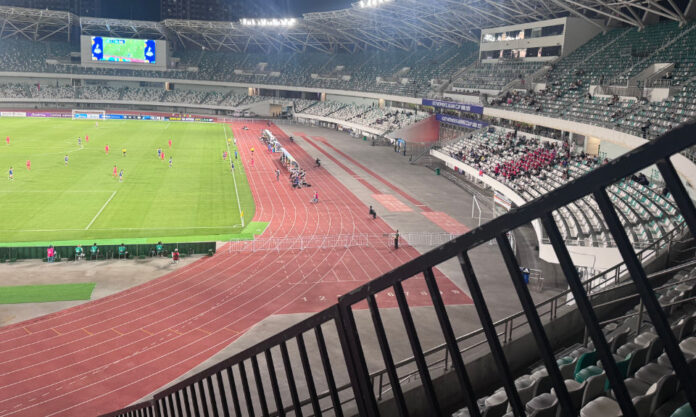
The crowd had its own story, and it was not only political. Official attendance was just 2,421 in a stadium built for 35,000, which gave the night an oddly hollow feel. A final should crackle. This one sometimes echoed.
Much of the local support was clearly with DPR Korea and, just as clearly, not especially fond of Japan. But the most striking image in the ground was the section holding around 100 North Korean supporters, barricaded off from the rest of the stadium. This was not some minor organisational quirk; it appeared to reflect the authorities’ determination to prevent any chance of defection.
That gave the evening a more serious edge than a youth final ought to carry. It was a reminder that even here, with 16-year-old girls playing football, politics was never entirely outside the gate. Still, that should remain background, not the main event. The match deserved to be seen first for what it was; an excellent, emphatic performance by DPR Korea.