






Streets regale us of stories, reflecting warmth in the shadows of the changing times, telling the vicissitudes of life over time and space, and revealing the prosperity of our City; the grandest City of Nanjing, for all its wondrous weirdness.
街道充满故事,在时代变迁的阴影中折射出温暖,诉说着时空的沧桑,展现着城市的繁华;南京最宏伟的城市,尽管它有很多奇妙的怪异之处。
Beginning up north in Nanjing off Zhongshan Bei Lu, jokesters may take pride in venturing down a street called “School Gate” (校门口), to then call a friend, leading to the inevitable question, “Where are you”?. Delight in friend’s frustration they will, safe in the knowledge they are already being as specific as possible.
从南京中山北路向北出发,爱开玩笑的人可能会自豪地冒险穿过一条名为“校门口”的街道,然后打电话给朋友,导致不可避免的问题,“你在哪里”?他们会为朋友的挫败感而高兴,因为他们已经尽可能具体地了解了这一点,这让他们感到安全。
Then there are those in Jiangning District taking bus 205, 715, 845, 846, 905 or D19. Their eyebrows shall surely be raised as is announced the stop at “Burial Mound” (坟头). Named after the nearby village, according to legend, during the Yongle period of the Ming Dynasty, the migrant workers who died while excavating ground for the Yangshan Stele are buried in this particular area.
江宁区乘坐205路、715路、845路、846路、905路、D19路公交车。当宣布停在“坟头”时,他们肯定会扬起眉毛。因附近的村庄而得名,相传明朝永乐年间,为仰山碑掘土时死去的民工就埋葬于此。
Back toward the centre of Nanjing, off Zhonghua Lu a little south of Baixia Lu, one will find Mud Horse Alley (泥马巷). Here, the legend has it that when the tenth Song Emperor, Zhao Gou, fled south, the mud horse in a temple in this alley appeared as a mythical beast and carried him across the Yangtze River. But in the modern day, and somewhat less romantically, the “mud horse” is also an internet meme based on a word play with a certain insulting profanity relating to one’s parent.
回到南京市中心,在白下路以南一点的中华路上,你会发现泥马巷。这里相传宋朝第十代皇帝赵构南逃时,巷子里寺庙里的泥马化作神兽,载着赵构渡过长江。但在现代,“泥马”也是一种基于文字游戏的互联网迷因,其中带有某种与父母相关的侮辱性脏话。

Still with cursing, “Swearing on a Bridge” (骂驾桥) off Qinhong Lu received its name after the extreme and repeated scoldings directed toward Founder of the Ming Dynasty, Zhu Yuanzhang, for his ungratefulness as a youngster.
秦洪路的“骂驾桥”仍是骂声不断,因对明朝开国皇帝朱元璋少年时忘恩负义的严厉斥责而得名。
Taking a walk from the east toward 1912 downtown, “Stone Grandma’s Nunnery” (石婆婆庵) implies the bringing of bad luck, while “Three Steps Two Bridges” (三步两桥), off Zhongshan Bei Lu near to Xinmofan Lu, begs the question, “Whose long legs can cross two bridges in just three steps?”.
从东边向1912市中心走去,“石婆婆庵”寓意着不吉利,而中山北路新磨坊路附近的“三步两桥”则引出了“谁的长腿能三步跨过两座桥”的疑问。
Not far away, students at Southeast University will be aware that their downtown campus is situated on “Four Decorated Arches” (四牌楼). Fair enough. “Three Decorated Arches”, on the other hand, lies south of Fujian Lu up north, while “Decorated Arch” lies down south off Guanghua Lu. But where “Two Decorated Arches” is to be found is another Nanjing mystery…
不远处,东南大学的学生就会发现,他们的市中心校园位于“四牌楼”。很公平。 “三花牌坊”位于福建路以南,北面是“花牌坊”,位于光华路以南。但“双花牌”到底在哪里,又是南京的一个谜……
Utilising more homonyms, “Chaoku Street” (钞库街) off Changle Lu could be thought of as “Super Cool Street”, while nearby is also “East Careful Bridge Street” (小心桥东街); a linguistic error dating from the Republican era allegedly, in which “star” (星) was mistaken for “heart” (心).
用更多的谐音,长乐路边的“钞库街”可以被认为是“超酷街”,附近还有“小心桥东街”;据称,这是一个民国时期的语言错误,其中“星”被误认为“心”。
But for Nanjing’s top two weird names, we need to head for bang in the middle of Xinjiekou, our city centre, where the pronunciation of “Big Silver Mace Lane” (大锏银巷) sounds like “Big Bitch Lane” (大贱人巷).
但南京最怪异的两个名字,就得去我们市中心新街口的中间,那里的“大锏银巷”读音像“大贱人巷”。
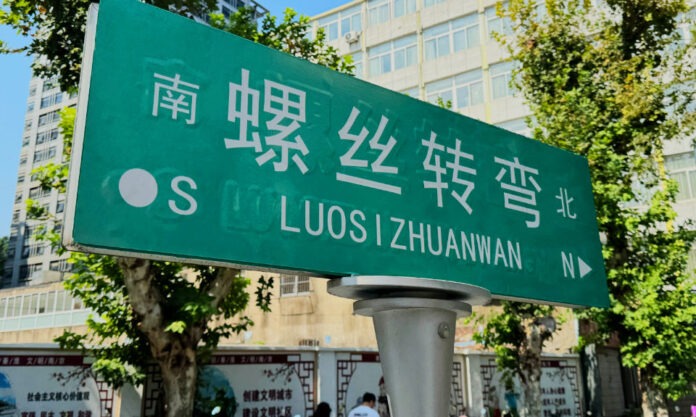
And not far away is the pièce de résistance; “Screw Turn” (螺丝转弯). While initially defying explanation, the name is in fact a homonym for Luo Temple, originally named Yanzuo Temple, that was located at the bend, or turn, in the road. Simples!
不远处就是主菜。 “螺丝转弯”(螺丝转弯)。虽然最初无法解释,但这个名字实际上是罗寺的谐音,原名延座寺,位于道路的拐弯处。简单!