





Nanjing’s darkest period in its history is back in headlines as China and the USA came together as one this past weekend, in recognition of the various tragedies suffered by women across Asia at the hands of the Japanese in the world’s biggest-ever conflict.
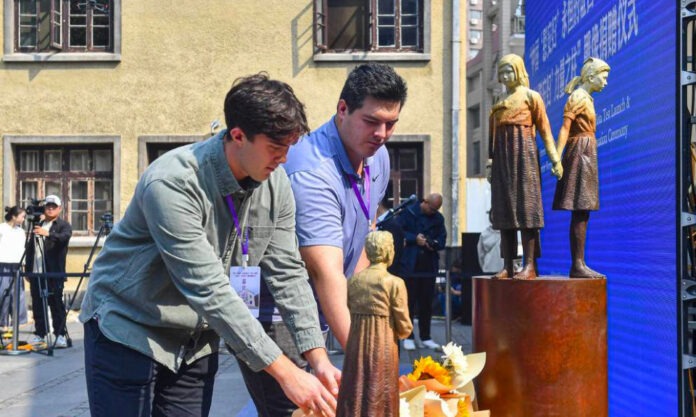
On the morning of October 14, the Memorial Hall of the Victims in Nanjing Massacre by Japanese Invaders held an unveiling ceremony for the statue pair in the Nanjing Sex Slave Museum that technically goes by the name of Nanjing Liji Lane Comfort Station Exhibition Hall.
The statue pair was presented by three representatives from China, South Korea and the Philippines, chosen for all being countries which suffered sexual abuse of their women by Japanese soldiers during World War II.
In essence a one third-size version of the pair in San Francisco, USA, by sculptor Steven Whyte, that was unveiled in the City’s St. Mary’s Square in September, 2017, both that in the USA and now the China statue pair share the name, “Comfort Women” Column of Strength.
As to the statues themselves, the dominant of the pair depicts three girls back to back, holding hands and looking forward with solemn expressions. They are watched from a distance by that of the lady who served as prototype; Kim Hak-sun, the first Korean victim of the Japanese military’s “comfort women” system to publicly expose the dark events of this time in history with her real name.
“To bear witness to the suffering experienced by tens of thousands of women and girls in 13 countries and regions who were enslaved by the Japanese army before and after the start of World War II”, reads a monument next to the statue pair.
Donor Lilian Sing, co-chairman of the “Comfort Women” Justice Coalition, is a retired judge. On Saturday she said, “I am very gratified that I am bringing my two grandsons with me this time. It is important that our history be passed on to the next generation”, as reports the Yangtze Evening News.
Sing’s grandson said that he only learned about the horrific events that occurred in China during World War II with his grandmother’s founding of the Coalition. He said, “As a young man, I hope this project inspires the next generation of Chinese and American young people to work together to spread knowledge about Asian history”. He further mentioned that he plans to establish a branch of the Coalition at the university he attends to let his peers understand this terrible tragedy.
The term, “Comfort Women”, is one not without controversy. The website, remembercomfortwomen.org states it as “the Japanese Imperial government’s euphemism for the women and children they trafficked as sex slaves between 1932 and 1945”. Closer to home, many in our City oppose its use, as the women it describes were at no point in any particular comfort.
Entrance is free to the Nanjing Sex Slave Museum, located at 2 Liji Lane in Daxinggong, that is also the only museum this publication has encountered in China open to over 14s only.