


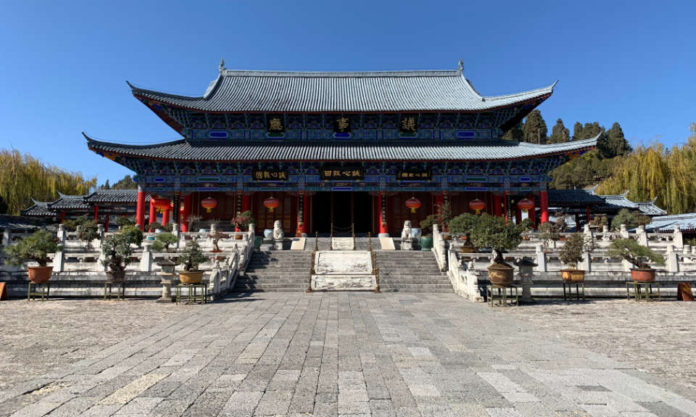
If there was one word to describe Yunnan, likely that word would be “spiritual”. And if there were roads to Heaven, they would look like the tarmac strips that ascend the skies over this gem of southwest China.
如果用一个词来形容云南,那很可能是“精神”。 如果有通往天堂的道路,它们将看起来像中国西南部这颗宝石上空的柏油路。
This is where the Himalayas begin.
这是喜马拉雅山脉开始的地方。
Yunnan is of course a huge tourist draw, particularly during China’s major holiday periods. Not so at Christmas, which is when The Nanjinger chose to go to Lijiang. It’s cold, for sure (a dry, bearable cold; lip balm essential), but the lack of people makes it tranquil.
云南当然是一个巨大的旅游吸引力,特别是在中国的主要节假日期间。 不是在圣诞节,那就是南京人选择去丽江的时候。 当然,天气很冷(干燥、可以忍受的感冒;润唇膏是必不可少的),但人少使它很平静。

Lijiang lies in northwestern Yunnan Province from where it is only about 100 kilometres to Myanmar as the crow flies. At an elevation of 2,400 metres, flying into Lijiang is excitement in itself, as the mountains on either side of the plane seem to get nearer and nearer.
丽江位于云南省西北部,距离缅甸只有大约100公里。 在海拔2400米的地方,飞往丽江本身就很兴奋,因为飞机两侧的山脉似乎越來越近。
Dawn of day 1 was spent waiting for the sun to rise sufficiently to reveal our target; Jade Dragon Snow Mountain that is the most southerly snowcapped mountain in the Northern Hemisphere. At 5,596 metres, it would tower 800 metres above Mont Blanc, the summit of Europe.
第1天的黎明是等待太阳升起,足以揭示我们的目标;玉龙雪山是北半球最南端的雪山。 它高5596米,高出欧洲山顶勃朗峰800米。

As part of the 5A scenic area, Yulong Snow Mountain National Scenic Area and National Geological Park, an ascent of the mountain was our first order of business. However, the increasingly blustery winds that morning forced a closure of the cable car that would have taken us most of the way, before a climb of a few hundred steps to one of the highest observation platforms in the world, elevation 4,680 metres.
作为5A景区、玉龙雪山国家风景区和国家地质公园的一部分,爬山是我们的首要工作。 然而,那天早上越来越大的狂风迫使缆车关闭,缆车本可以带我们走大部分路,然后爬上几百级台阶,到达世界上最高的观景台之一,海拔4680米。
The disappointment was only partial, as everywhere we looked were views that were almost biblical.
失望只是部分的,因为我们到处都是近乎圣经的观点。
With all three of us feeling the effects of altitude sickness kicking in, this is where the disposable oxygen bottles came out. And where our driver’s advice and local knowledge became a great enhancement to the holiday. He then turned the car southwards, destination Zhoucheng town on the outskirts of Dali, 2 hours drive away.
我们三个人都感受到了高原反应的影响,这就是一次性氧气瓶出现的地方。 在那里,我们的司机的建议和当地知识极大地提升了假期。 然后他把车转向南方,目的地是大理郊区的周城镇,车程2小时。
This is the home of the irresistible summer accessory that is tie dye.
这是不可抗拒的扎染夏季配饰的故乡。
While the craft itself is thought to date back to the central plains of China 1,000 years ago, in Zhoucheng, tie dye is practiced by the Bai people, just one of the 25 ethnic minorities which comprise some 38 percent of the Yunnan population.
虽然这种工艺本身被认为可以追溯到1000年前的中国中部平原,但在周城,扎染是由白人实行的,白人只是占云南人口约38%的25个少数民族之一。
Our tie-dye teacher was an old woman who spoke in the Bai tongue that is one of the Tibeto-Burman languages. Making an uneducated guess at one word in ten, we fumbled our way through the stitching, twisting and tying part of the process, after which our creations were plumped into the vast wooden vat of isatus tinctoria for the dying.
我们的扎染老师是一位老太太,她用藏缅语之一的白方言说话。 在十分之一的单词中,我们摸索着缝制、扭曲和打结部分,然后我们的创作被塞进巨大的木桶里,供死亡。

Their proximity to those great, wide skies has given the Bai their favourite colours. The blue and white can be seen everywhere; from their tie dye to their architecture. It is said that the contrast of these two colours reflect the beauty and simplicity of the Bai’s peaceful and tolerant minds.
他们靠近那些伟大而宽阔的天空,使白人获得了他们最喜欢的颜色。 蓝色和白色随处可见;从扎染到建筑。 据说,这两种颜色的对比反映了白族和平和宽容的心灵的美丽和简单。
Back in Lijiang, the World Cultural Heritage Site that is Lijiang Old Town is the most important traditional habitat of the Naxi ethnic minority. Indeed, the majority of the 300,000-strong tribe live in Lijiang. There, the Naxi ancients created the “Dongba” script that dates back to the 7th century. It is now the only living hieroglyph in the world.
回到丽江,世界文化遗产丽江老城是纳西少数民族最重要的传统栖息地。 事实上,这个30万人的部落中的大多数都居住在丽江。 在那里,纳西古人创造了可以追溯到7世纪的“东巴”文字。 它现在是世界上唯一活着的象形文字。

Treading the cobblestones of the Old Town is the way to discover hidden delights, such as the museum that tells of the Ancient Tea Horse Road. With Myanmar and Bengal at one end, and Tibet and Sichuan Province at the other, Yunnan was the link along which Tibetan ponies were traded for Chinese tea in a practice dating back at least 1,000 years. Such sturdy horses were vital in China’s fighting of the warring nomads in the north.
踏上老城区的鹅卵石是发现隐藏乐趣的方式,例如讲述古代茶马路的博物馆。 一端是缅甸和孟加拉,另一端是西藏和四川省,云南是西藏小马与中国茶交易的纽带,这种做法可以追溯到至少1000年前。 如此健壮的马匹在中国北方交战游牧民族的斗争中至关重要。
As a worthwhile break from the geographical monotony of China’s eastern China, the Trip to Yunnan was also standout for us as an underscoring of the vast diversity of the Chinese people.
作为对中国东部地理单调的一次值得突破,云南之行对我们来说也很突出,它凸显了中国人民的巨大多样性。
If you don’t like the cold, and don’t mind a few crowds, The Nanjinger recommends to visit Yunnan in April, May or October (avoiding holidays).
如果你不喜欢寒冷,也不介意人多,《南京人》建议在4月、5月或10月(避免节假日)访问云南。